
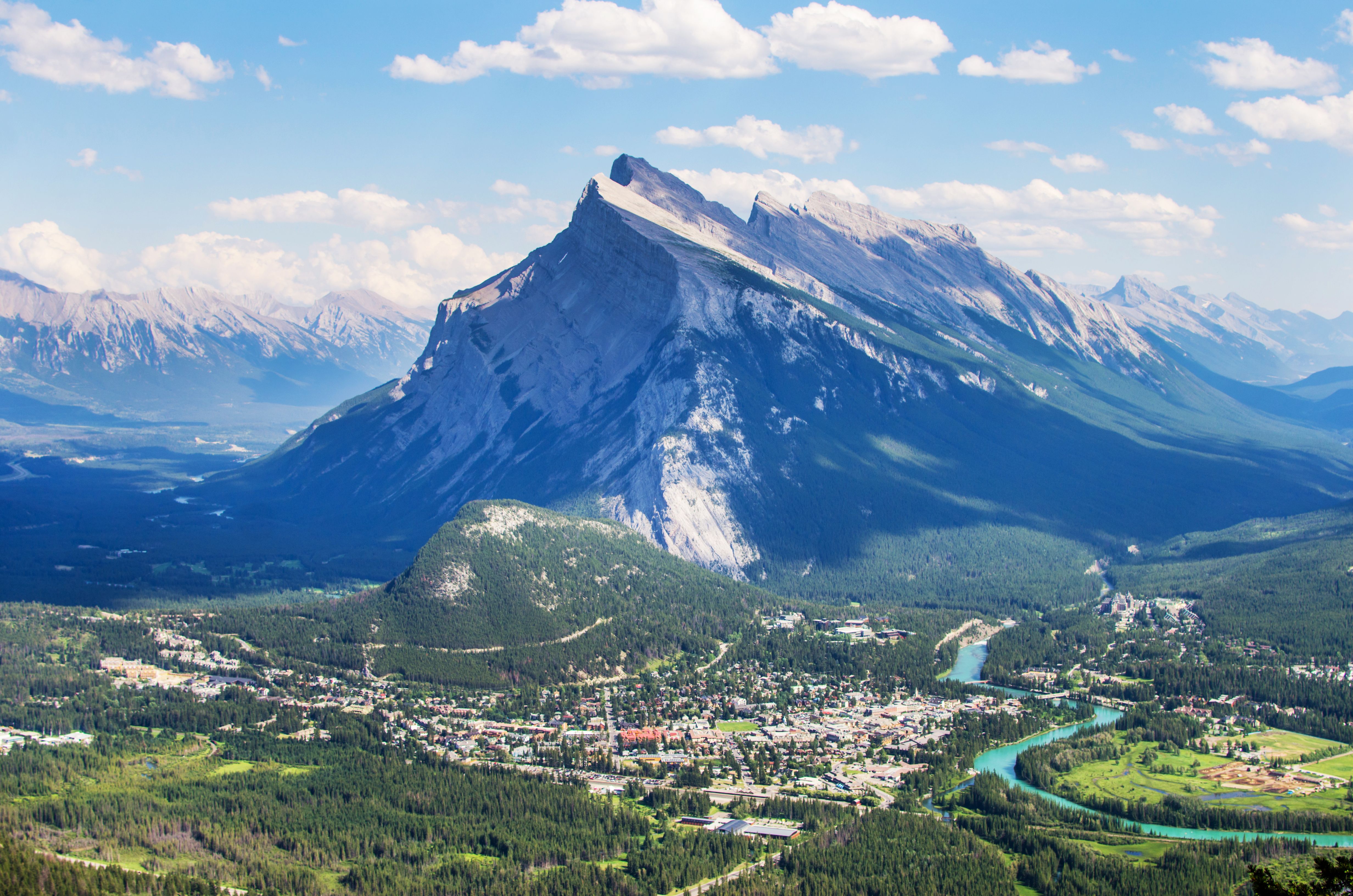
Stretching from the icy tundras of the Arctic Circle to the tropical beaches of the Caribbean coastline, North America is a continent defined by contrast. It is home to towering mountain ranges, vast prairies, dense forests, and some of the world's busiest cities. Covering roughly 24.7 million square kilometers, it is the third largest continent on Earth, and it holds a population of more than 590 million people spread across 23 sovereign countries and numerous territories.
North America's landscape is as varied as its people. The continent stretches across several distinct geographic regions, each with its own character.
In the west, the Rocky Mountains run like a spine from Canada down through the United States, giving way to the Sierra Nevada and the Cascade Range along the Pacific coast. These mountains shape weather patterns, feed rivers, and support ecosystems ranging from alpine tundra to temperate rainforest.
To the east lies the older, gentler range of the Appalachian Mountains, worn smooth by hundreds of millions of years of erosion. Between the two mountain systems sit the Great Plains, an enormous expanse of grassland that has long served as the agricultural heartland of the continent, producing wheat, corn, and soybeans on a massive scale.
Further north, Canada's boreal forest, often called the taiga, forms one of the largest forested regions on the planet, while the Arctic reaches of Alaska, northern Canada, and Greenland remain covered in snow and permafrost for much of the year. To the south, Mexico and the countries of Central America transition into tropical climates, home to rainforests, volcanic peaks, and coral reefs along both coasts.
The continent is also bordered by three oceans, the Atlantic to the east, the Pacific to the west, and the Arctic to the north, along with the Gulf of Mexico and the Caribbean Sea to the south. This access to multiple bodies of water has shaped trade routes, migration patterns, and coastal economies for centuries.
Long before European colonization, North America was home to hundreds of Indigenous nations, each with distinct languages, governance systems, and traditions. Groups such as the Iroquois Confederacy, the Navajo, the Aztec, and the Maya built complex societies with sophisticated agricultural, architectural, and astronomical knowledge. Their influence remains visible today in place names, foods, art, and cultural practices across the continent.
Beginning in the late fifteenth century, waves of European colonization, followed by the transatlantic slave trade and later immigration from Asia, Africa, and the Middle East, transformed the demographic makeup of the continent. Today, North America is one of the most culturally diverse regions in the world. English, Spanish, and French are the dominant languages, though hundreds of Indigenous and immigrant languages are still spoken throughout the continent.
This diversity is reflected in everything from cuisine to music. Tex-Mex, Cajun, and soul food in the United States; poutine and tourtière in Canada; mole and tamales in Mexico; and jerk chicken across the Caribbean all tell a story of cultures blending, adapting, and creating something new.
North America is one of the most economically influential regions in the world. The United States alone accounts for a significant share of global GDP, and the continent as a whole is a leader in technology, agriculture, manufacturing, energy production, and finance.
The United States, Canada, and Mexico are bound together by deep trade relationships, formalized most recently through the United States Mexico Canada Agreement (USMCA), which replaced the earlier NAFTA framework. Goods, services, and labor move across these borders daily, linking supply chains from auto manufacturing in the Midwest and Ontario to agricultural exports from Mexico's Bajio region.
Silicon Valley in California remains a global center for technology and innovation, while cities like New York, Toronto, and Mexico City serve as major financial and cultural hubs. At the same time, smaller economies across Central America and the Caribbean contribute significantly through tourism, agriculture, and increasingly, digital services.
North America's cities are as diverse as its landscapes. New York City, with its dense skyline and constant motion, stands as a global center of finance, media, and culture. Los Angeles anchors the entertainment industry, while Chicago blends architectural history with a thriving arts scene.
In Canada, Toronto and Vancouver rank among the most livable and multicultural cities in the world, while Mexico City, one of the largest metropolitan areas on the planet, combines ancient Aztec history with modern urban energy. Smaller but equally distinctive cities, from Montreal's European charm to Havana's colonial architecture, add further texture to the continent's urban identity.
Few continents can match North America's natural wonders. The Grand Canyon in Arizona reveals nearly two billion years of geological history carved by the Colorado River. Niagara Falls, straddling the border between the United States and Canada, draws millions of visitors each year with its raw power and beauty. Yellowstone National Park, the world's first national park, protects geothermal features found almost nowhere else on Earth, alongside populations of bison, wolves, and grizzly bears.
Further south, the Baja California peninsula and the reefs off Belize offer some of the richest marine biodiversity in the Western Hemisphere, while the cloud forests of Costa Rica and Panama support an extraordinary range of plant and animal life.
North America's story is far from finished. Climate change is reshaping coastlines, forests, and weather patterns. Migration continues to redraw demographic lines. Economic ties between countries deepen even as political relationships shift. Indigenous communities continue to fight for recognition and rights, while cities grow and reinvent themselves for a new century.
What remains constant is the continent's remarkable diversity, in its land, its people, and its possibilities. From the northern reaches of the Arctic to the tropical south, North America continues to be a place where distinct histories and cultures meet, clash, and combine to create something uniquely its own.